
For several years now, around Christmas – when the trees are bare and bands of tits ricochet through the hedgerows – I have driven to a converted farmhouse in Cheshire to stay with a group of physicist friends. I believe the house was initially chosen for its rare combination of seven bedrooms, seven bathrooms and a hot tub, but the really magical feature of the property is its setting: the farm lies two kilometres from Jodrell Bank and the Lovell radio telescope is visible from every window at the front of the house.
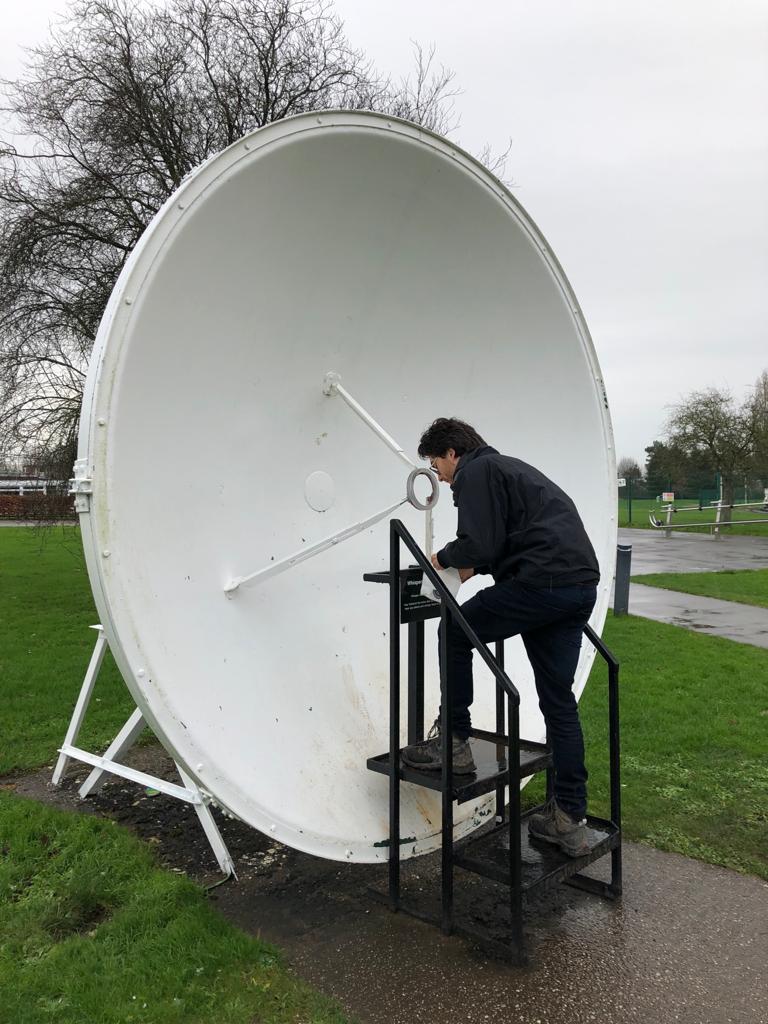
The Lovell telescope consists of a wide, shallow bowl, 76m in diameter, supported on two sides by towers and an exoskeleton of steel girders [1]. A white rod protrudes from the bowl like a rude stamen with an antenna at its tip. The telescope is mounted on circular tracks that allow it to swivel 360 degrees and point in almost any direction. I will often notice it in one position while drinking my morning tea – then, when I set out for a walk an hour later, it is looking at a completely different part of the sky. The bowl is made from steel to reflect radio waves and its shape allows the telescope to intercept and concentrate extremely faint signals. If a cross-section were cut out of the bowl it would form a parabolic curve, so the bowl is called a paraboloid of revolution [1]. Paraboloids are special because light rays arriving parallel to each other and striking any part of the paraboloid surface will be reflected and meet at the same point – the focus. This means that a radio antenna held at the bowl focus will detect an amplified signal collected from the full span of the telescope. It also works in reverse, so a signal sent out from the antenna will be reflected into a parallel beam for radio ranging (radar). The welcome centre at Jodrell Bank has a wonderful demonstration of this effect using sound waves. Two “whispering dishes”, a couple of metres in diameter, are positioned opposite one another at a distance of about twenty metres. Sound waves are reflected by each dish just as radio waves are reflected by the Lovell telescope, which means that if you whisper at the focus of one dish, a friend standing at the focus of the other will be able to hear you distinctly.

One of the most striking aspects of the Lovell telescope – something that is superficially evident long before you think about the telescope as an instrument – is that it is a beautiful piece of architecture. One can talk about “economy of form” or “sensitivity to construction materials”, but I think its peculiar beauty comes from a commitment to function – like a tugboat or stealth plane. It is a scientific instrument – enormous, incongruous – which somehow complements the landscape around it.
Herrigel and Persig have famously written about Zen in the context of archery and motorcycle maintenance. They describe how practitioners of a given discipline can reach such a pitch of mastery that “[t]he nonchalance which he forfeited at the beginning of his instruction…” returns at the end as an “indestructible characteristic” [2]. Quality derives from unselfconscious practice, where the product occurs as an involuntary, ego-less action. Perhaps this is easier to achieve when designing a scientific instrument than an ordinary work of architecture because the requirements are well-defined and exacting. The Lovell telescope must be able to pick up radio waves from space, as well as track the motion of satellites and ballistic missiles. This places strict limitations on form, size and weight: a reduction in bowl radius or quality of curvature will lead to a quantifiable loss of sensitivity. The human ego is irrelevant to these considerations.
In modern municipal architecture there appears to be a lack of sympathy that prevents beautiful buildings from being produced. Often cost is prioritized over elegance, practicality, durability, or sustainability. Cold, hard lines of Euclid and uniform surfaces are in vogue, while traditional proportions and decorative features are replaced by a pabulum of offset panels. Despite a general appreciation that organic forms have a salutary effect on human psychology, we consistently use shapes and textures inimical to Nature.
An interesting case study is provided by Le Corbusier’s Cité Frugès in Pessac, Bordeaux [4]. Designed as low-cost housing for Henry Frugès’ factory workers, the buildings had flat roofs, elongated windows and bare outer walls that gave an unnatural sense of homogeneity. The design was poorly received and after Frugès’ workers refused to move in, the houses were put up for sale. Eventually, with the introduction of cheap government loans for low-income workers, residents were able to buy the flats they were living in [5]. They started to customize their properties by repainting walls and adding flower boxes, decorating gables and putting shutters on windows. There were also practical considerations: leaking flat roofs were converted into pitched roofs and bespoke window shapes were altered because the residents could find no standardized replacements [5]. If all of the workers living in the Cité Frugès were forced to become bricoleurs to make the buildings feel habitable, it suggests there was a fault somewhere in the design process. Le Corbusier did not consider how the lives of the factory workers should inform his design. He felt his taste in architecture was superior, asserting a hard-edged aseptic idealism – his ego – on a green suburb with its own architectural traditions. Unlike the engineers and scientists who worked on the Lovell telescope, I suspect Le Corbusier didn’t understand the parameters of his brief well enough to produce a beautiful piece of architecture.
References and Further Reading
[1] https://www.jodrellbank.net/visit/whats-here/lovell-telescope/
[2] E. Herrigel. Zen in the Art of Archery. Routledge & Kegan Paul Ltd, pp. 102, 1953.
[3] R. M. Persig. Zen and the Art of Motorcycle Maintenance. Corgi, 1981.
[4] P. Boudon. Lived-in Architecture: Le Corbusier’s Pessac Revisited. MIT Press, 1972.
[5] P. Steadman. “Life is Always Right: It is the Architect who is Wrong”. https://www.philipsteadman.com/blog/life-is-always-right-it-is-the-architect-who-is-wrong/ Accessed: 29/12/21.
 Philip Bradford