Le Chemin de Saint-Jacques: From Angst to Ataraxia

Old Adonis. Itero de la Vega, October 2021. Taken with Apple iPhone.

Life is a dream of significance. Under the normal conditions of work, provided the pay is not too low, the job not too arduous or self-evidently fatuous, our daily routine assumes a grand psychological importance. This importance is necessary to continue functioning in society. If you start to lose interest in your work and the work is intellectually demanding, your health will suffer and neurosis may turn to nervous collapse. The ultimate meaninglessness of everything is only apprehended – indeed, is only important – when an external event forces us to wake up from our collective hypnosis; when the fire gutters and the shadows on the wall suddenly assume an inhuman aspect.

A pilgrim is created when somebody has, in a certain sense, seen the candle flicker in the magic lantern. When I decided to walk the Camino de Santiago in the autumn of 2021, I had just finished my PhD and a short post-doctoral position. After years of study, my conditions of life were changing and my way of looking at life was changing as well. I walked because I wanted answers to certain insoluble questions – not because I wanted to do glory to God. This was also true of many of my fellow pilgrims. It was remarkably rare to see someone who was walking purely as a gesture of obeisance. Only once did I cross paths with someone I felt might have walked solely out of deference to God: a man who, when he arrived in the square at the foot of the cathedral of Santiago, gave a great shout and dropped to his knees, his cheeks rimed with tears, and provided the crowd of tourists and pilgrims with something original to add to their Instagram accounts. For the majority of serious long-distance pilgrims, however – whether they were religious, soi-disant “spiritual” or secular – their real motivation for walking was anxiety. This anxiety was a psychological reaction to the fundamental indifference of the world to our desires – the absurdity of the human condition. Properly expressed, existential angst is an appreciation of l’absurdité du monde.

The absurdity of the human condition can be glimpsed following a single profound event or gradual accumulation of experiences. Whether the person is trying to make an important decision or process some past trauma, engaging with their anxiety on an intellectual level will require them to answer specific questions about their life. Among the pilgrims I met on the road to Santiago, questions about love or work or death were the most common. And though everyone walks with their own precious cache of personal questions, most were united by a single quality that I call “ill-posedness”. An ill-posed question can be grammatically articulated but contains no objective meaning. Questions of this sort are impossible to attack intellectually – only emotionally. Examples of some ill-posed questions are: What is the sound of green? What lies north of the north pole? What is the meaning of life? What should I do now my husband is dead? Or even the transparently self-defeating: What made everything that exists? Some of these questions can be made meaningful with a small qualification, such as “What should I do to be happy?”. Others are irredeemably fallacious.

A pilgrim’s response to an existential question can be religious, mystical, philosophical, or some heretical combination of the three. But whichever approach they take, by walking the road to Santiago they are accepting that they have failed to find an answer by conventional means. A rearrangement of perspective is required, so they choose the freedom of a fixed routine where all supplementary problems are subordinated to walking, shelter and sustenance. If the pilgrim is religious, their existential problem is recast as a question of Faith and they walk in the hope that they will find consolation in the power of a loving God. Of course if you are not religious then you are measuring your anxiety against the fundamental indifference of the Universe. Fear demands consolation and atheism is psychologically unsatisfying unless you feel in control of yourself or your life. You may even understand that the questions you want answers to are not meaningful. Rather than attempt the impossible task of answering existential questions directly, we can discuss the psychological experience of absurdity and point to a way – the only generally-applicable way – to escape existential anxiety.

Un Cheval dans la Salle de Bains

Absurdity can be defined as the discontinuity between human desire and reality. It is perceived when the world contradicts your expectations in an illuminating way, engendering an appreciation of the meaninglessness of everything, of your own loneliness, of the universe’s ultimate indifference. One might say that a person feels absurd when they understand that their opinion is irrelevant to the global functioning of the Universe. The clouds in the sky and the currents of the great oceans do not conspire to please you; if you are struck by a train the steel does not yield sympathetically on impact. Even in the 21st Century, it is frighteningly common to die without knowing great love or receiving profound inspiration. All these facts are self-evident but difficult to understand without a certain quality of perspective. It is moreover curious that this sense of absurdity can be a source of wonder or sorrow depending on context. The sense of personal insignificance that strikes you at the summit of a mountain, or when looking into the eyes of a wild animal, has the same root as your reaction to being diagnosed with a terminal illness.

Since absurdity arises out of the relationship between human expectations and a real event, the experience of absurdity will occur differently for different people. It can strike in the most mundane setting: an ordinary-looking bin is fixed to a lamp-post, but as you pass you see that the interior is burnt out and filled with ribbons of melted plastic like wet viscera; or a man dressed in clean, fashionable clothes suddenly halts by the side of the road, prostrates himself and opens his palms to beg. There is a brief moment of dislocation, when your mind rushes to assimilate the unexpected. One can also imagine really exceptional experiences that permanently disturb your mental picture of reality. The banal horror of war reverberated through 20th Western literature in the works of Céline, Orwell, Vonnegut, Heller and Ballard. Though they responded sometimes in very different ways, these authors all saw the baffling, super-human indifference of the world to suffering. In his Hitchhiker’s Guide to the Galaxy series, Douglas Adams took the idea of a super-human perspective to its ridiculous limit when he imagined a machine that allows you to briefly appreciate your own size relative to that of the entire Universe. Invented by Trin Tragula to annoy his hectoring wife, the Total Perspective Vortex affords the user an all-too-realistic “sense of proportion”. Though the shock of comprehension annihilated his poor wife’s mind, Tragula found consolation in having proved that “if life was going to exist in a Universe of this size, then the one thing it could not afford to have was a sense of proportion” [1].

Absurdity is likewise apparent in social contrasts. Consider the juxtaposition of a young girl absorbed in her smartphone, an atavistic smile curling at the edges of her glossy lips, while a stream of young African men cycle past who are forced to work for delivery companies for lack of papers. Then there is me, holding an umbrella, watching an elderly refugee as she shelters under an awning in the pouring rain. Her nose and mouth are covered by a surgical mask and she is rocking mechanically from side to side – either to comfort herself, or perhaps in a spasm of boredom. In the five metres that separate me from this woman is captured all the hypocrisy of humanity and all the indifference of the Universe.

There is the sick man denied health, the curious woman denied understanding and unification, Sisyphus with his rock… These unfortunates all live with frustrated desires and are daily confronted with the absurd.

Absurdity can also be found in Sartre’s nauseating tree root, or any other object, properly considered. The only requirement is that the thing appear sufficiently super-human. Go for a walk in the countryside at night and turn your gaze to the moon. Look at it as dispassionately as you can – not as a bright coin, a symbol, or a character in a story. You will see how utterly impersonal and indifferent it is. Camus describes the image of a man speaking inside a telephone box. You can see him gesticulating behind the glass, his mouth working silently and animatedly, and the incongruity of the image provokes you to wonder: Who is this man? What does he live for? In a way, he allows you a glimpse of yourself from above. Your own absurdity is reflected in him. The simplicity of your shared desires and their inherent contradictions, their incredible smallness.

The Response

Having woken up to the absurdity of the world, you may be tempted to ask: how should I respond to it? We have mentioned the pilgrims already, who try to walk themselves out of neurosis and then (if they are successful) enter back into society. If you lose hope but retain desire then you may be deranged by the “cruel” indifference of the world. You can dedicate yourself to an imagined all-powerful parent-figure, a principle or abstraction. Finally, you can attempt to accept absurdity with equanimity. This last, philosophical approach is infinitely more interesting than the religious response because it does not require you to wrap your brain around a Möbius loop of false metaphysics or adhere to a corpus of outdated ethics. Philosophical progress can be analyzed. You know your approach is correct if you converge on the essential truths that the more enlightened practitioners of the world’s great religions and philosophies have created. These truths are old and well-documented. It is no coincidence that the Stoics, Buddhists, Sufis, Hindus, Quakers, Taoists, Bokononists (and so on ad nauseum) are all ultimately searching for an island of emotional stability, or ataraxia1. If absurdity arises out of a discontinuity between reality and human expectations, our only hope is to adjust our expectations – to weaken desire but retain hope. This in the knowledge that even the most exceptional Stoic life is absurd, since humans are biological creatures and an elevated state of consciousness cannot be permanent in a world where people can be tortured on a spiked chair. In this way, eyes fixed cheerfully on the undulating road in front of them, a good philosopher asymptotes towards the limit of Enlightenment.

Lenticular clouds between Brazuelo and Ponferrada, October 2021. Taken with Apple iPhone.

1All great religious thinkers gravitate towards the same ideas because the human condition hasn’t changed and won’t change while we remain biologically human. Ataraxia is the only spiritual goal that can be generally applied and therefore is the only quest suitable for a world religion.

[1] Douglas Adams, The Restaurant at the End of the Universe, Pan Books (1980)

Speak, Memory: An Unflattering Portrait of Johnson’s Conservative Government

‘Muriel,’ she said, ‘read me the Fourth Commandment. Does it not say something about never sleeping in a bed?’

With some difficulty Muriel spelt it out.

‘It says, “No animal shall sleep in a bed with sheets”,’ she announced finally.

Curiously enough, Clover had not remembered that the Fourth Commandment mentioned sheets; but as it was there on the wall, it must have done so.

George Orwell, Animal Farm [Penguin Books, pp.60, 1960]

The furore over the Downing Street Covid parties has been extreme. For days the 24-hour news media has been ploughing the selfsame furrow, asking anyone they can find whether they think it is bad that the Prime Minister broke his own Covid rules. The responses have been predictably unenlightening. Few openly deny that his actions were wrong, although a cadre of Johnson’s supporters parry the question, asserting that he is sincerely sorry although he may not in fact be culpable after all, that he has an unimpeachable record and we shall have to wait for the results of the official inquiry rather than expect the Prime Minister to deliver up the details himself. The really interesting question, however, is why does the public suddenly care? For years we have greeted revelations of corruption, transparent lies and a raft of other offenses under Johnson’s government with perfect insouciance, but when it is proved he went briefly to a party while the rest of us were isolating – now we are angry, we bay like hounds! And yet – perhaps not. Even now somehow the mud refuses to stick. Jacob Rees-Mogg shrugs off criticism of the Prime Minister in a Newsnight interview and many still see Johnson as a beleaguered but lovable political outsider. This therefore seems an appropriate time to review some of Johnson’s more pungent misdemeanours, lest we forget and become lulled into a false sense of democracy.

Writing an account of political events from your bedroom always runs the risk of missing important details, but independent coverage from journalists in The Guardian, The Times, Private Eye and a slew of other papers have painted – cumulatively – an unequivocal and damning portrait of Johnson’s administration. These articles describe how he has exploited unenforceable rules in the ministerial code of conduct [1], allowing ministers to use underhand or illegal tactics to strengthen their hold on government and enrich their families and friends.

The primary objective of Johnson’s Conservative party is to consolidate power1 – a creed manifestly incompatible with democratic government. Three well-established requirements for democracy are a free press, freedom to demonstrate peacefully against the government and the existence of independent institutions that can evaluate government decisions and punish wrongdoing. Based on major news items published since 2019, I think there is evidence that all three are being eroded by Johnson’s government.

Johnson undermines regulation by infiltrating [2,3,4] or attempting to dismantle [5,6] impartial watchdogs. Official investigations are hampered or delayed [6, 7] and if the regulator finds a Conservative minister has breached the code of conduct then Johnson refuses to punish or even acknowledge wrongdoing. The result is that quality of government suffers but a “strong and stable” core of loyal politicians is retained.

Johnson has tried to silence peaceful protest by giving the police powers to shut down any demonstration deemed arbitrarily noisy or disruptive [8]. The BBC has been punished for its independence and journalistic rigour with funding cuts [9] and attempts to install Lord Moore as chairman – a Tory peer and former editor of the Daily Telegraph [10]. Besides Moore, two further Tory Press barons have been ennobled by Johnson for “services to journalism” [11]. The Conservative party has also manipulated video footage and used bogus social media profiles to try to damage the credibility of Labour [12,13].

Looking back on these events, I am reminded more of a banana republic than a democracy. In a Vanity Fair article from 2009, the late Christopher Hitchens observed that a chief characteristic of banana republics is that of “kleptocracy, whereby those in positions of influence use their time in office to maximize their own gains… At all costs, therefore, the one principle that must not operate is the principle of accountability” [14]. I will explore this idea with a line-up of Johnson’s cabinet ministers.

Robert Jenrick served as Secretary of State for Housing between 2019 and 2021. In 2020, he was pressured by media tycoon Richard Desmond to grant planning permission for a £1bn housing development on the Westferry Printworks so that he could avoid paying a £45m local council tax levy that is used to support the London borough of Tower Hamlets – one of the poorest boroughs in the city. Tower Hamlets Council and the government’s own planning advisor had rejected the scheme, citing concerns about high housing density, scale and affordability [15]. Jenrick, however, approved the development and two weeks later the Conservative Party received a £12k quid pro quo from Desmond. In one text message sent to Jenrick before he granted planning permission, Desmond pushed for a quick decision because “we don’t want to give the Marxists load of doe [sic] for nothing.” Andrew Wood, former Conservative councillor for Tower Hamlets, resigned in disgust at the decision but Johnson quickly announced that he had “full confidence” in his Housing Minister. Though Jenrick’s lawyers tried to prevent the release of official documents pertaining to his decision, he was later forced to admit that his approval of Desmond’s development was illegal. The Westferry Printworks scandal remains a shining example of how rich “donors” can attend Tory fundraising events and buy favours from prominent MPs. Astonishingly, Jenrick still denies any bias in making his decision.

When Jenrick twice applied for planning permission to extend his house in Westminster, both applications were denied by planning officers because the extension would “harm the appearance of the building and the conservation area” [16]. Two months after Jenrick was elected MP, his wife submitted a third planning application. Again, planning officers recommended the extension be refused, but Tory councillor (and Jenrick’s neighbour) Steve Summers made an official request that the decision be passed over to a planning committee. In November 2014, the three Tory members of the committee voted to overturn the planning officer’s decision and grant permission for Jenrick to go ahead with his extension. The one Labour member of the committee voted against the proposed changes. Paul Church, one of the Tory planning committee members, complained later on Twitter about the culture in Westminster local government [17]: “I tried to stand up for the communities I was elected to represent against the dominance of property developers & their agents, patronage & power in Westminster, but I was bullied, silenced & threatened by their powerful allies.”

Matt Hancock, Secretary of State for Health and Social Care between 2018 and 2021, oversaw the UK’s Covid response and was widely criticized for awarding billions of pounds in PPE contracts to companies with political ties to the Conservative party. A report from the National Audit Office (NAO) in November 2020 found that 58% of Covid PPE contracts were awarded without being put out to tender, while a sample of these contracts revealed that several had been passed with no record of why the decision was taken or if there were any conflicts of interest. In some cases, a person was simply phoned and offered a contract without a shortlist of alternative candidates being drawn up or formal interviews taking place. According to the NAO, the government was not clear or “timely” in its release of information [7]. Many of the companies employed by the government were found to have no experience of anything – let alone PPE procurement – having lain dormant for years before reanimating, phoenix-like, during the pandemic. One can picture the oligarchs nodding in happy recognition.

Hancock also promoted friends and lovers to top positions in government, including Baroness Dido Harding (a Tory peer, wife of a Tory MP and Hancock’s tennis partner) and Gina Coladangelo (director and major shareholder in lobbying firm Luther Pendragon, with whom he was later found to be having an affair). Both women were afforded significant influence over the running of the NHS and there have been questions about their qualification for each role. Harding was ultimately responsible for the UK Test and Trace system that was supposed to track the progress of infection and help prevent its spread. The £37bn scheme2, heavily reliant on expensive private consultants and unskilled temporary staff, was designed to prevent a second lockdown [18]. The UK has since gone through two further lockdowns and neither the SAGE panel, nor an all-party public accounts committee, have been able to find any evidence of a measurable impact on the pandemic. I will just take a moment to allow the magnitude of that statement to sink in… In the words of Nick Macpherson, a former Permanent Secretary of the Treasury, the Test and Trace system represents “the most wasteful and inept public spending programme of all time” [19]. Hancock enjoyed Johnson’s favour throughout his tenure as Health Secretary, only being sacked was when he was caught in an extra-marital embrace with Coladangelo on Westminster CCTV.

Priti Patel has served as Home Secretary since 2019. In 2020, an investigation by Number 10’s adviser on ministerial standards found that she had bullied staff and broken the ministerial code, but Patel received no formal admonition and was not sacked. On learning of the Prime Minister’s continued support for Patel, Johnson’s adviser resigned in protest [20].

In March 2021, Patel’s department produced a “Police, Crime, Sentencing and Courts Bill” that proposed sinister alterations to the laws surrounding peaceful protest. After the bill was submitted to the House of Lords, the Home Office made 18 pages of amendments intended to give police and the Home Office absolute control over the ways people are allowed to protest in the UK. Under the amended rules, demonstrations that are arbitrarily deemed too noisy, or which block roads, can immediately be shut down by the police. Members of the public can be searched if they look like they might be going to do something disruptive and if found with superglue on their person can be jailed for over a year. Despite no opposition from Conservatives, the bill provoked an outcry from democratic groups and opposition MPs. When the bill was debated in Parliament, DUP MP Gavin Robinson articulated the thoughts of many [21]:

“… I rail against, in the strongest possible terms, the overarching, sweeping and draconian provisions on protest… The loose and lazy way this legislation is drafted would make a dictator blush. Protests will be noisy, protests will disrupt and no matter how offensive we may find the issue at their heart, the right to protest should be protected.”

Fortunately, the House of Lords recently blocked Patel’s additions to the bill.

Finally we come to Johnson’s own record as Prime Minister. He began by introducing two new words into our everyday language: “unprecedented”, which was used to excuse every mistake made by the Conservatives inside or outside the pandemic; and “prorogue”, a previously abstruse jargon-word, rudely exhumed when Johnson advised the Queen to dissolve Parliament on 28 August 2019. The prorogation was intended to force through a Brexit Deal and avoid Parliamentary scrutiny of the government’s Brexit plans, but in September 2019 it was deemed unlawful by the Supreme Court. This was followed by an Internal Market Bill that breached international law and provoked a rain of resignations from government and the civil service [22]. In July 2020, Boris Johnson announced 36 new life peers despite claims that he was committed to reducing the size of the House of Lords. The announcement was made in the first days of summer recess, when the government cannot be challenged in Parliament [11] and many of the new appointees – friends, family members, party donors and media moguls [23] – had no supporting qualifications besides a conflict of interest. It was Johnson’s government that created the “VIP lane” for Covid contracts that the High court has recently declared illegal [24]. Following a 2-year independent investigation by the parliamentary standards commissioner, Conservative MP Owen Paterson was found to be in “egregious” breach of lobbying rules by “repeatedly” approaching ministers on behalf of two companies that were paying him a salary exceeding £100k [25]. Against the commissioner’s advice, the government voted to spare Paterson a 30-day suspension from Parliament and abolish the standards committee – proposing a new committee with a Conservative chair and majority [5]. Shortly after the vote, Business Secretary Kwasi Kwarteng stated on Sky News [26]:

“I think it’s difficult to see what the future of the commissioner is, given the fact that we’re reviewing the process, and we’re overturning and trying to reform this whole process, but it’s up to the commissioner to decide her position.”

The uproar that followed, with ringing denouncements in the press and from MPs of all parties, forced the government to reverse its decision the following day and accept the findings of the Standards Committee. Paterson resigned, but complained bitterly about the unfairness of the report and denied all accusations of wrongdoing. Johnson has likewise refused to apologize for the government’s actions [27].

One might reasonably observe that all this was to be expected, given Johnson’s longstanding contempt for the truth and for taxpayer’s money. One could cite his sacking from the Times for fabricating a quote [28], the tens of millions of pounds he spent on disastrous projects as Mayor of London [29], or his lies about the £350m a week that could be salvaged from the EU after Brexit and given to the NHS [30]… But we started with the Conservative Covid party scandal and it is illustrative of Johnson’s political genius. First he simply denied that the parties ever took place. When email evidence was produced, Johnson conceded that they may have taken place but that all government Covid guidance was followed [31]. When photos then emerged of guests not following the rules, he claimed he had little knowledge of the details despite the fact that they took place in the Downing Street garden. Finally, Johnson was forced to accept that he actually attended a garden party but that he felt it was a “work event” [32]. When Johnson offered his staggeringly disingenuous apology during Prime Minister’s Questions, stressing that it was his past judgement which was at fault, Keir Starmer pointedly recalled that ministers “who knowingly mislead parliament will be expected to offer their resignation”. Under current rules there is no way to enforce this, but the results of Sue Gray’s inquiry may force Johnson’s hand.

Why, then, do we care that he broke the Covid isolation rules and went to a party? Relative to all the other things Johnson has done – the repeated lying, the ineptitude, the authoritarian creep – it is trivial. One of the most important lessons from the Covid crisis and Brexit is how banana-shaped our democracy is. Our political systems are not designed to stop people with no morals – we saw it in America with Trump and we have seen it in the UK with Johnson. People are now calling for the ministerial code of conduct to become law [33]. The government has an Advisory Committee on Business Appointments (ACoBA) that can investigate conflicts of interest, but it sorely needs the power to veto appointments [34].

It is a fact that politicians with, for example, egregious views on climate change, education, taxation or voting reform, may still have a better idea than you about how to solve a problem. Recognizing that there are intelligent people on both sides of the Commons is at the root of political collaboration and problem-solving, but the danger of Johnsonian/Trumpian tactics is that they harm our belief in this principle. By repeatedly lying and pumping money into their own bank accounts, they build themselves up as our political enemies. They have decided they are not interested in compromise or power-sharing, accountability or Deutsch’s “error correction” [35]. Therefore we are in danger of becoming like them – unable to listen to good advice.

Though it may seem counter-productive to criticize a handful of Conservative kleptocrats, the fact remains that Johnson’s government is still standing. Revisiting their various offences helps us understand how a democratic system can be manipulated. It also allows us to cut through Johnson’s persistent verbiage, because the only way to identify a po-faced lie is to remember the truth. If an MP is happy to lie when it suits them, repeatedly ignore questions, deny misconduct even when it has been proven, hamper official investigations or even fabricate evidence, then before anything else can be done we must remember.

1As evidenced by their willingness to gift anything from a peerage to planning approval, provided they can leverage a sufficient bribe.

2And rising!

References and Further Reading

[1] The Seven Principles of Public Life (the Nolan Principles), Committee on Standards in Public Life, UK government, 31 May 1995. URL: https://www.gov.uk/government/publications/the-7-principles-of-public-life/the-7-principles-of-public-life–2

[2] David Parsley, the i, Lord Pickles: Government lobbying watchdog head has top role in lobbying group, URL: https://inews.co.uk/news/politics/lord-pickles-government-lobbying-watchdog-head-role-group-959388

[3] Peter Geoghegan, Lobbying watchdog chair failed to publicly declare role on Tory business forum, openDemocracy UK, URL: https://www.opendemocracy.net/en/opendemocracyuk/lobbying-watchdog-chair-failed-publicly-declare-role-tory-business-forum/

[4] Bully Girls, Private Eye, 1563, pp. 15, 18 Dec – 6 Jan 2022.

[5] Toby Helm, Jon Ungoed-Thomas, Michael Savage and Tom Wall, Return of the sleazy party: the Conservatives and the Owen Paterson affair, the Guardian, URL: https://www.theguardian.com/politics/2021/nov/07/return-of-the-sleazy-party-the-conservatives-and-the-owen-paterson-affair

[6] Peter Walker, Tory plan to scrap election watchdog ‘undermines democracy’, the Guardian, 31 Aug 2020. URL: https://www.theguardian.com/politics/2020/aug/31/tory-plans-to-scrap-election-watchdog-undermines-democracy

[7] Investigation into government procurement during the COVID-19 pandemic, National Audit Office, 2020. URL: https://www.nao.org.uk/press-release/investigation-into-government-procurement-during-the-covid-19-pandemic/

[8] India Bourke, Peaceful protest is under threat from the new UK Policing Bill, the New Statesman, 9 December 2021. URL: https://www.newstatesman.com/environment/climate/2021/12/peaceful-protest-is-under-threat-from-the-new-uk-policing-bill

[9] Jim Waterson, BBC licence fee to be abolished in 2027 and funding frozen, the Guardian, 16 Jan 2022. URL: https://www.theguardian.com/media/2022/jan/16/bbc-licence-fee-to-be-abolished-in-2027-and-funding-frozen

[10] Dan Sabbagh, No 10 told Charles Moore appointment could put BBC’s independence at risk, the Guardian, 27 Sep 2020. URL: https://www.theguardian.com/media/2020/sep/27/no-10-told-charles-moore-appointment-could-put-bbcs-independence-at-risk

[11] Queen’s Birthday Honours, Private Eye, 1533, pp. 16, 23 Oct-5 Nov 2020.

[12] Jim Waterson and Rajeev Syal, Keir Starmer: Tories’ doctored TV footage is ‘act of desperation’, the Guardian, 6 Nov 2019. URL: https://www.theguardian.com/media/2019/nov/05/tories-unrepentant-about-doctored-video-of-keir-starmer-tv-appearance

[13] Jim Waterson, Tories pretend to be factchecking service during leaders’ debate, the Guardian, 19 Nov 2019. URL: https://www.theguardian.com/politics/2019/nov/19/tories-tweet-anti-labour-posts-under-factcheckuk-brand

[14] Christopher Hitchens, America the Banana Republic, Arguably, Atlantic Books, pp. 94-95, 2011.

[15] Minister accepts Isle of Dogs housing development ‘was unlawful’, BBC News, 27 May 2020. https://www.bbc.co.uk/news/uk-england-london-52826751

[16] Billy Kenber, Tories gave Robert Jenrick home renovation the go-ahead, The Times, 24 June 2020. URL: https://www.thetimes.co.uk/article/tories-gave-robert-jenrick-home-renovation-the-go-ahead-9s6580zkm

[17] Paul Church, Twitter, 25 Feb 2018. URL: https://twitter.com/pauljchurch/status/967834976610865152

[18] “Unimaginable” cost of Test & Trace failed to deliver central promise of averting another lockdown, UK Parliament, 10 March 2021. URL: https://committees.parliament.uk/committee/127/public-accounts-committee/news/150988/unimaginable-cost-of-test-trace-failed-to-deliver-central-promise-of-averting-another-lockdown/

[19] Andrew Woodcock, Treasury’s former top mandarin blasts test and trace as ‘most wasteful spending of all time’, the Independent, 10 March 2021. URL: https://www.independent.co.uk/news/uk/politics/test-trace-coronavirus-harding-macpherson-b1815057.html

[20] Heather Stewart and Simon Murphy, Boris Johnson adviser quits after being overruled on Priti Patel bullying report, the Guardian, 20 Nov 2020. URL: https://www.theguardian.com/politics/2020/nov/20/priti-patel-boris-johnson-bullying-report-findings

[21] Gavin Robinson, Debate: Police, Crime, Sentencing and Courts Bill, 2nd reading, Tuesday 16th March 2021. URL: https://www.parallelparliament.co.uk/mp/gavin-robinson/debate/2021-03-16/commons/commons-chamber/police-crime-sentencing-and-courts-bill

[22] Lord Keen: Senior law officer quits over Brexit bill row, BBC News, 16 September 2020. URL: https://www.bbc.co.uk/news/uk-scotland-scotland-politics-54179745

[23] Peter Walker and Ben Quinn, Boris Johnson ‘still committed to Lords reduction’ despite 36 peerages, the Guardian, 3 Aug 2020. URL: https://www.theguardian.com/politics/2020/aug/03/no-10-boris-johnson-pm-still-committed-lords-reduction-despite-36-peerages

[24] David Conn, Emails emerge of ‘VIP route’ for UK Covid test contracts, the Guardian, 23 Sep 2021. URL: https://www.theguardian.com/world/2021/sep/23/emails-emerge-of-vip-route-for-uk-covid-test-contracts

[25] Committee on Standards publish report on the conduct of Rt Hon Owen Paterson MP, UK Parliament, 26 Oct 2021. URL: https://committees.parliament.uk/committee/290/committee-on-standards/news/158246/committee-on-standards-publish-report-on-the-conduct-of-rt-hon-owen-paterson-mp/

[26] Alastair Reed, Owen Paterson lobbying scandal: What’s it all about?, The Big Issue, 4 Nov 2021. URL: https://www.bigissue.com/news/politics/owen-paterson-lobbying-scandal-whats-it-all-about/

[27] Aubrey Allegretti, Owen Paterson: his claims and how they stack up in analysis, the Guardian, 3 Nov 2021. URL: https://www.theguardian.com/politics/2021/nov/03/owen-paterson-his-claims-and-how-they-stack-up-in-analysis

[28] Peter Stubley, Boris Johnson: The most infamous lies and untruths by the Conservative leadership candidate, the Independent, 25 May 2019. URL: https://www.independent.co.uk/news/uk/politics/boris-johnson-lies-conservative-leader-candidate-list-times-banana-brexit-bus-a8929076.html

[29] Matthew Weaver, Boris Johnson ‘ignored expert advice’ over £1bn mayoral vanity projects, the Guardian, 16 Jul 2019. URL: https://www.theguardian.com/politics/2019/jul/16/boris-johnson-accused-of-costing-taxpayers-1bn-on-london-mayor-projects

[30] UK Statistics Authority statement on the use of official statistics on contributions to the European Union, UK Statistics Authority, 27 May 2016. URL: https://uksa.statisticsauthority.gov.uk/news/uk-statistics-authority-statement-on-the-use-of-official-statistics-on-contributions-to-the-european-union/

[31] Chris Stafford, Boris Johnson’s Downing Street party apology: three key takeaways, The Conversation, 12 Jan 2022. URL: https://theconversation.com/boris-johnsons-downing-street-party-apology-three-key-takeaways-174814

[32] Nick Hopkins and Rajeev Syal, Boris Johnson’s No 10 lockdown party apology: what he said and what he meant, the Guardian, 12 Jan 2022. URL: https://www.theguardian.com/politics/ng-interactive/2022/jan/12/boris-johnson-no-10-lockdown-party-apology-what-he-said-and-what-he-meant

[33] Daniel Bruce, It’s time for the Ministerial Code to become law, URL: https://www.transparency.org.uk/ministerial-code-UK-nolan-principles-public-ethical-standards

[34] Written evidence submitted by the Advisory Committee on Business Appointments, Public Administration Committee, UK Parliament URL: https://publications.parliament.uk/pa/cm201213/cmselect/cmpubadm/404/404we03.htm

[35] Sam Knight, What Will Brexit Britain Be Like?, The New Yorker, 31 Jan 2020. URL: https://www.newyorker.com/news/letter-from-the-uk/what-will-brexit-britain-be-like

The I Ching in the 21st Century

Ask a physicist friend to consult the I Ching – an ancient Chinese divination text – and you will probably receive a look of profound disdain. If you happen to be a physicist yourself then your friend’s eyebrows may threaten to leave their forehead altogether. It seems almost a betrayal of trust: a person they affectionately considered rational is abruptly exposed as a closet magician. Can he be serious? they wonder. Next he will ask to read my horoscope! I would like to talk a little here about why this reaction, while understandable, is wrong.

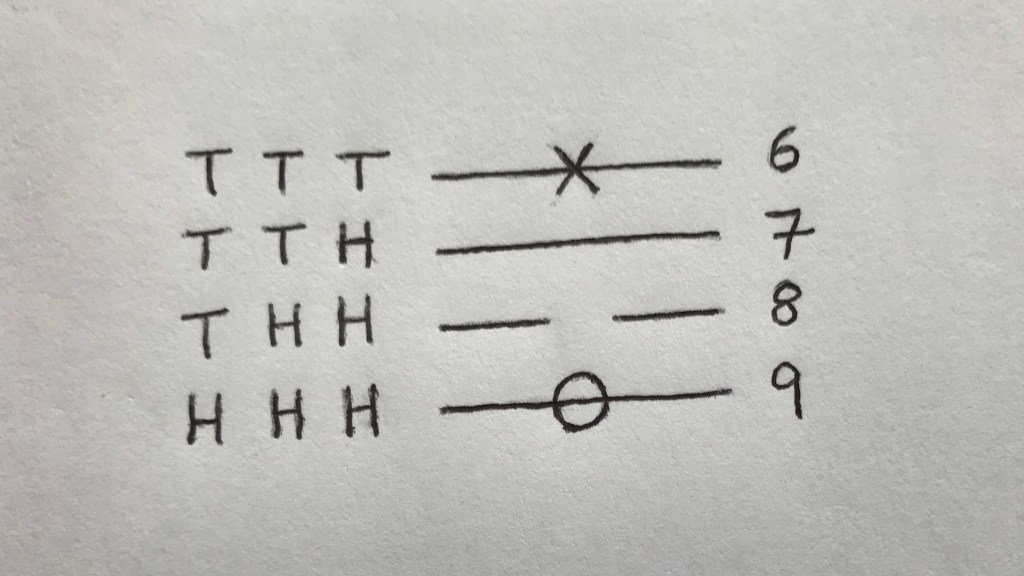
Traditionally the I Ching is said to be a “living” book because it is capable of responding, in a limited way, to any question asked of it. One begins by posing a question and the oracle’s response is given as a hexagram – an image built out of six lines arranged vertically on the page. The hexagram is found by throwing coins or separating out random bunches of yarrow stalks. I will explain the coin method here, as it is relatively simple. Tails has the value 2 and heads has the value 3, representing yin and yang respectively. Three coins are thrown at once and the number of heads and tails recorded. The sum of the three coin values corresponds to a particular type of line and the coins are tossed six times to produce a full hexagram of six lines. In Fig. 1 I have drawn a diagram of all the different coin combinations and the lines they produce. For example, two tails and one head gives 2+2+3=7, which corresponds to an unbroken line. Less likely is the result 3+3+3=9, forming the so-called old yang, represented by a circle with a line through it. The oracle contains 64 hexagrams of broken and unbroken lines – 64 possible answers – with the floating lines 6 and 9 adding texture to each prophecy.

FIG 1: The four line types used to form hexagrams in the I Ching.

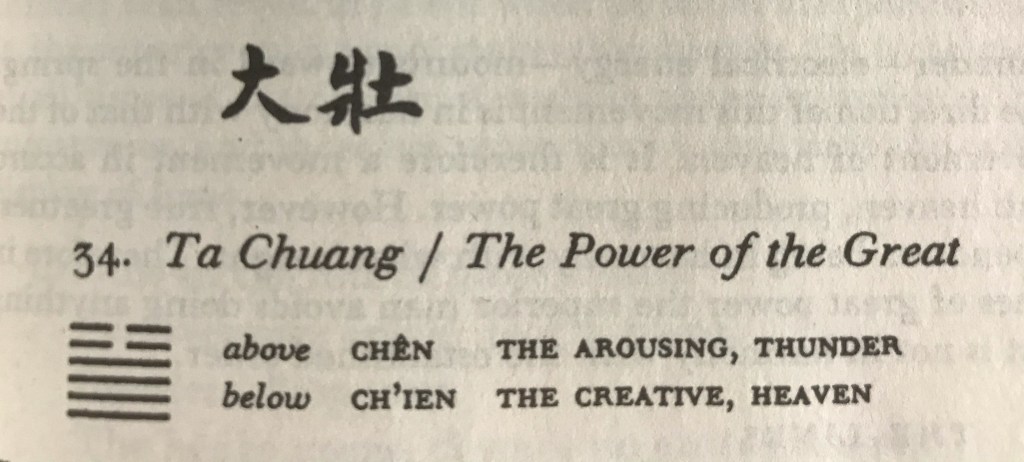
How does an abstract hexagram provide you with an answer to a question? Much of the work has been done for you by Chinese sages over millennia. Through long meditation they have tried to tease out meaning from interrelationships of form. They have dissected the hexagrams into two trigrams, or even further; they have related these components to abstract principles or concrete images, examined their relationships and proposed an interpretation. For you it remains to read the commentary on each hexagram provided by experts. The I Ching that you buy in a shop is really a collection of these commentaries. To help illustrate the process, Fig. 2 contains a picture of hexagram 34 – Ta Chuang, or The Power of the Great [1]. The Richard Wilhelm translation of the I Ching states that four solid, light lines enter the hexagram from below and are poised to ascend higher. The lower trigram represents strength and the upper movement: “..The union of movement and strength gives the meaning of THE POWER OF THE GREAT”. Thus a narrative is developed. From here, a body of broader philosophical significance has been built up over several thousand years. Your task, finally, is to read these commentaries and decide how they apply to the situation at hand.

FIG 2: The hexagram Ta Chuang. Photograph of pg 133 from [1].

Educated Westerners will often dismiss the I Ching as useless because they think you have to believe in magic to derive any benefit from it. According to tradition, the tossing of three coins or separating bunches of yarrow stalks is connected, in that moment, with your state of consciousness and all the aspects of the Universe at the time. The oracle’s answer therefore grows naturally out of the soil of the instant. As Douglas Adams’ character Dirk Gently would say, the value of the I Ching hinges on the “fundamental interconnectedness of all things”. While it is true that all things are connected, so to speak, in space and time, this has no influence on the quality of the oracle’s predictions. Statistical laws dictate that replacing this molecule of gas with another that is moving in a slightly different way will have no impact on the macroscopic properties of the gas (e.g. its temperature or pressure). In a similar way, although a coin toss is “rooted in the moment” [2], the present and future state of the universe cannot be meaningfully imprinted in the outcome. Unlike the old sages, I think the procedure of generating the hexagrams is random and I certainly don’t believe the hexagrams are convoked by “spiritual agencies” [3] residing in the book.

Anecdotal evidence suggests that meaningful answers are the rule rather than the exception when consulting the I Ching. How can this be, if the book operates on chance? The reason, of course, is that a human agent must apply the commentary provided in the I Ching to their own problem. Sometimes the interpretation seems straightforward, while at other times it is more obscure. Ultimately though it is the process of interpretation that is useful: you are asked to look at your problem from a fresh vantage, illuminated by the form of the hexagram. The human mind is able to interpret the symbolic meaning of things – the denotation of the letter “a”, an equals sign, a musical note – but the relationship between meaning and image is bilateral. Sometimes this two-way relationship can lead to nonsense interpretations, like when people pointed to the rubble of the World Trade Centre in 2001, observing that a cross-beam of two steel girders had survived in the form a crucifix. For some this was seen as a message from God instead of a statistically probable arrangement of two girders that had been bolted together. In other contexts, drawing meaning from images can lead to extraordinary revelations. A famous example is provided by August Kekulé, who had been working on the structure of benzene around the middle of the 19th Century. Speaking at a conference about how he made his discovery, Kekulé said he had dreamed of a snake biting its own tail and awoke with the realization that benzene must be ring-shaped!

It may be that a constant, subconscious reinterpretation of our surroundings is at the root of inspiration itself. Imagine that you have a difficult problem and decide to go for a long walk, perhaps for many weeks. There are some obvious benefits that anyone can identify: walking long distances hauls you out of your daily context, introduces you to physical hardship, deprives you of mass media culture (provided you do not spend the whole time connected to your phone) and hopefully grants you some perspective on your problems. There is another important advantage, which in truth can occur anywhere, at anytime, but which is particularly fruitful when one is walking out in the wilderness. Points in the landscape give rise to new thoughts because their appearance suggests things to the subconscious mind. The brain appears to work associatively and new discoveries hinge on our ability to combine old concepts in new ways. The landscape therefore offers up unlooked-for solutions, similar to the way the I Ching can help to recast problems and guide you towards a decision. There is no doubt that the major advantages of going on a long journey involve distancing yourself physically and mentally from normal life, but I wonder if there is this other aspect too: an unconscious unravelling of signs that can be a source of inspiration.

The I Ching can also have a more direct influence on creativity. Ursula K. LeGuin makes reference to the oracle several times in The Left Hand of Darkness [4] and Philip K. Dick famously used it to help write his novel The Man in the High Castle [5]. Dick’s story is an alternative history of the world, where the Axis powers won the Second World War and America has been partitioned into the Japanese-ruled Pacific States and German-controlled States on the Atlantic coast. The I Ching even appears directly in the text: all the major characters consult the oracle and Taoism is presented as an enlightened counterpoint to the fascist ideology of the Nazis. At several points Dick allows us into the mind of his character Nobusuke Tagomi, head of the Japanese Trade Mission in San Francisco. A particularly interesting passage comes towards the end of the book, when Tagomi is sitting on a park bench and looking at a piece of American jewellery he has just purchased. Tagomi has killed a man in self-defense and the action has shaken him. Finding no answers in the oracle, he has come across this jewellery made by one of the book’s other characters. A believer in the interconnectedness of things, Tagomi hopes the object holds the key to his situation [5]:

“He held the squiggle of silver. Reflection of the midday sun like boxtop cereal trinket, sent-away acquired Jack Armstrong magnifying mirror. Or – he gazed down into it. Om, as the Brahmins say. Shrunk spot in which all is captured. Both, at least in hint. The size, the shape.”

Tagomi perseveres:

“Metal is from the earth, he thought as he scrutinized. From below: that land which is lowest, the most dense… The daemonic world of the immutable; the time-that-was.

“And yet, in the sunlight, the silver triangle glittered. It reflected light. Fire, Mr Tagomi thought. Not dank or dark object at all. Not heavy, weary, but pulsing with life… Which are you? he asked the silver squiggle. Dark dead yin or brilliant living yang? In his palm the silver squiggle danced and blinded him…”

Here we are granted a glimpse of the Taoist perspective. Some of the advantages and limitations of this way of thinking are exposed. Using the I Ching can excite a new aesthetic appreciation of the world, a fascination with the most nondescript objects, a re-evaluation of their significance. The oracle is more than two thousand years old, but younger than the mind of modern man. People can still use the wisdom contained in the I Ching to help them work through their problems. Eventually, perhaps, it may tell us interesting things about human psychology and creativity.

References and Further Reading

[1] R. Wilhelm and C. F. Baynes and C. G. Jung, The I Ching; Or, Book of Changes: The Richard Wilhelm Translation Rendered Into English, Third Edition. Penguin Books, 2003.

[2] P. K. Dick and E. Brown, The Man in the High Castle. Penguin Classics, pp. 19, 2001.

[3] R. Wilhelm and C. F. Baynes and C. G. Jung, The I Ching; Or, Book of Changes: The Richard Wilhelm Translation Rendered Into English, Third Edition. Penguin Books, pp. xxv, 2003.

[4] U. K. LeGuin and C. Miéville, The Left Hand of Darkness, Gollancz, pp. 60, 2017.

[5] P. K. Dick and E. Brown, The Man in the High Castle. Penguin Classics, pp. 218-221, 2001.

Flies in Your Eyes?

Humour me. Picture a world where people can hook themselves to a virtually-augmented reality at any time: a “filter stream” that papers over cracks in the pavement as you walk, builds illusory towers into the line of the horizon, plays music to constantly manipulate your mood within predefined limits, allows you to modify your appearance with impunity and affords hackers and programmers supernatural powers of exploitation. Picture people walking around, so absorbed in this liminal fiction that they wouldn’t notice a fly walking on the whites of their eyes. While this fantasy has been deliberately exaggerated, the concepts are familiar. I believe this is essentially the state of England in 2021 and that it is becoming an increasingly realistic depiction. Many of us carry smartphones and noise-cancelling headphones when we go out to walk, run, or do any form of exercise. We now bring smartphones into the toilet with us because idle time seems threatening and unproductive. As these practices move from habit to reflex, we lose touch with the reality that makes us feel invested in society. It is not just beautiful things that are lost: we miss the potholes, the crumbling stucco façades, a curl of cellophane grimacing on the asphalt, the shops that were, the coffee shops that are, plastic toys bobbing in a swollen river – indestructible and banal. All these things form a wellspring of political feeling in people. Their ugliness is provocative, interrogative, but these impressions quickly fade when you are absorbed in your favourite podcast.


Can we say when the advantages of using digital technology begin to be discoloured by over-reliance? While it is hard to present a general rule, we can point to some unambiguous symptoms. Gradually, the daily commute becomes a virtual experience. We find it hard to leave the house without a phone, though our reasoning may at times be difficult to justify. Eventually, we stop being able to identify lies told by politicians because we have stopped looking beyond our screens for evidence or allowed ourselves the time to evaluate their claims. People increasingly rely on atavistic reactions to form opinions. Five seconds is considered an embarrassing eternity of thought, so we consult a search engine and find a host of ready-made answers. In this way we can become superficially “well-informed”, scrolling through news feeds every day, while preserving a fairly basic understanding of events and possessing little ability to weigh evidence ourselves. Statistics were released daily during the pandemic, over months, but they contributed little to the average person’s grasp of the situation. Articles tell us how long it should take to read them so you can squeeze them in to a hectic schedule, but there is no thought that they should be re-read or digested over the course of a week. Shorter articles are preferred and become as disposable as a paper napkin. One may even draw an analogy with food consumption: like food, quality of information should be emphasized over quantity and speed of delivery.

I think it is doubtful that the average Westerner has become significantly cleverer, more knowledgeable or, indeed, happier since the advent of the internet. This, despite the enormous technological advances presented by instantaneous free access to information. In his 1955 article entitled “Can We Survive Technology?”, Von Neumann observes that:

“Since most time scales are fixed by human reaction times, habits, and other physiological and psychological factors, the effect of the increased speed of technological processes [during the Industrial Revolution] was to enlarge the size of units — political, organizational, economic, and cultural — affected by technological operations. That is, instead of performing the same operations as before in less time, now larger-scale operations were performed in the same time.”

I think this idea could apply just as well to the Information Age as the Industrial Revolution.

Zuckerberg’s “metaverse” is the natural culmination of our over-reliance on digital technology. It is a monument to the ideology of “can implies should” – a solution to a problem nobody has. It is remarkable that after forty years of cyberpunk and dystopian science fiction stories warning us about pursuing virtual lives at the expense of our physical environment, educated people are becoming enthusiastic about the prospect of moving almost every aspect of our lives online. The point of Huxley’s “soma” and Bradbury’s sinister “TV parlours” were to show that human happiness goes beyond a regular injection of serotonin; indeed, that an over-reliance on technology can actually be harmful.

References and Further Reading

[1] J. Von Neumann, Can We Survive Technology? Fortune, 1955.

[2] A. Huxley, Brave New World, Vintage Classics, Random House, 2008.

[3] R. Bradbury, Fahrenheit 451: A Novel, Simon & Schuster, 2012.

A Watched Kettle…

It is a kettle in white plastic. Being old and well-used, the plastic is grimy everywhere except around the handle. When I open the lid I see that the heating element is coated in limescale and there are chalky scabs floating in the water at the bottom. Looking at it like this, in one superficial drag, is mildly unpleasant. The materials look cheap, the design mean. At this point I don’t have much idea of how the thing works and if a part of it were to break I wouldn’t know how to repair it. I realise, as I probe my mental image of the kettle, that I wouldn’t have the inclination either. I harbour a degree of antipathy towards it, as though the kettle is being deliberately offensive. The shoddiness of the design has somehow personified the product. It is a sort of synecdoche for “Technology” – Robert Persig’s impersonal “death force” that transfixes people and gives rise to ill-conceived machines that rule over humanity [1]. And this thing is in my house! A mysterious object and consequently hostile.

But there is an alternative way to look at a kettle. With a little effort I can view the object in terms of its function. What is it for? What does it represent? We all know that an electric kettle is a water heater. There is a resistive element in the base that can be connected to the mains electricity supply. As current is drawn through this element it heats up significantly (it has a relatively high electrical resistance) and this heat is transferred to the water by conduction. The kettle appears less threatening from this lofty vantage. It is true to its function and the fact that it is dirty and leaks all over the table top when full are just interesting aspects of this particular kettle. One can always go deeper, of course. I can recall that the plastic casing would probably have been die-cast with molten pellets of polypropylene. Though this makes the kettle difficult to recycle, polypropylene is a remarkably versatile insulating material. There is a crude logic to making it out of plastic. The unsightly accumulation of limescale arrives courtesy of geography. I live in an area with hard water – that is, the water contains minerals like calcium carbonate because it has percolated through layers of chalk or limestone. When the water boils, this calcium carbonate is deposited on adjacent surfaces. It seems the closer I look, the more unique my kettle becomes. Abstract knowledge about the kettle is enhancing its beauty. In Unweaving the Rainbow, Richard Dawkins talks at length about the aesthetic appreciation that develops hand-in-hand with scientific enquiry. He quotes the Nobel-prizewinning physicist Richard Feynman [2,3]: “I don’t see how studying a flower ever detracts from its beauty. It only adds.”

We have covered two ways of seeing: one is a superficial, aesthetic mode and the other a functional, or abstract mode. Both perspectives are valid and useful because they supply complementary information about the nature of an object – but now I can feel you eyeing your immaculate glass kettle with LED illumination… Fortunately, these ideas also apply outside of the kitchen. I first encountered them while I was working at the Rutherford Appleton Laboratory. Between wrangling oscilloscopes and electromagnetic probes, I was reading Zen and the Art of Motorcycle Maintenance and learning how to learn. Initially I found the whole layout of the campus oppressive. I hated the superhuman scale of everything – the glass, the steel, the sham elegance, the anonymity. Later, armed with a way of looking at things in terms of their function, I started to think about why the environment was designed as it was and what exactly was wrong with it.

Psychogeographers will be familiar with these ideas too. A psychogeographer travels around cities and other urban environments in a state of high receptivity – alert to the emotions engendered by buildings and other man-made structures. I think it is difficult to exist in modern cities without an abstract appreciation of your surroundings. How should a sympathetic person respond to the hot press of the London metro system, or the appalling vacuity of an airport shopping arcade? People cope by looking inwards: they listen to music, meticulously track how fast and how far they run, they listen to podcasts. All these activities are admirable in moderation, but eventually they alienate you from the reality of your environment. The author Will Self has often talked about the importance of walking without artificial distraction – he perambulates for miles across London and even to and from airports. In this way he builds a contiguous mental picture of the landscape and his movements within it. Many of us live in miniature worlds connected by disorienting, machine-assisted journeys [3]. We must become involved in where we live so we can discriminate between good and bad design, become less neurotic, more sympathetic and even, perhaps, more political.

References and Further Reading

[1] R. M. Persig. Zen and the Art of Motorcycle Maintenance. Corgi, pp. 13, 1981.

[2] R. Dawkins, Unweaving the Rainbow: Science, Delusion and the Appetite for Wonder, Penguin, 2006 .

[3] A. Seckel, Remembering Richard Feynman, The Skeptical Inquirer, Vol. XII (4) 1988.

[3] W. Self, Psychogeography. https://www.youtube.com/watch?v=zVEgOiB7Bo8 First Accessed: 1 July 2018

Zen and the Art of Radio Astronomy

The Lovell radio telescope (Mark I) – December 2017

For several years now, around Christmas – when the trees are bare and bands of tits ricochet through the hedgerows – I have driven to a converted farmhouse in Cheshire to stay with a group of physicist friends. I believe the house was initially chosen for its rare combination of seven bedrooms, seven bathrooms and a hot tub, but the really magical feature of the property is its setting: the farm lies two kilometres from Jodrell Bank and the Lovell radio telescope is visible from every window at the front of the house.

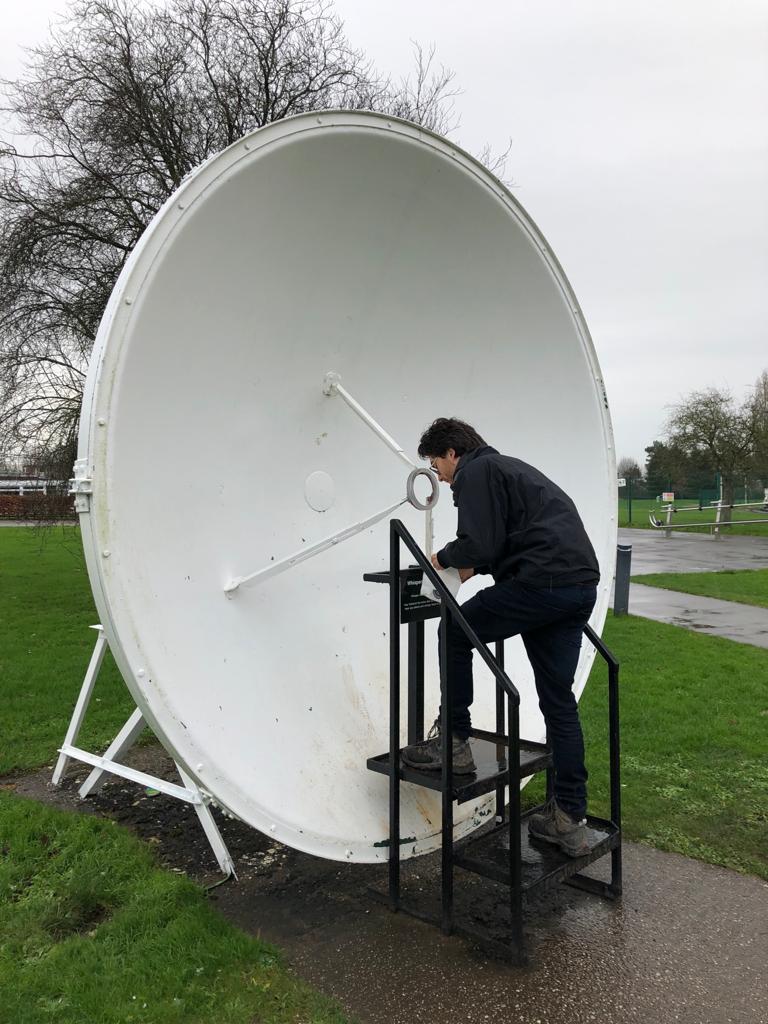
The Lovell telescope consists of a wide, shallow bowl, 76m in diameter, supported on two sides by towers and an exoskeleton of steel girders [1]. A white rod protrudes from the bowl like a rude stamen with an antenna at its tip. The telescope is mounted on circular tracks that allow it to swivel 360 degrees and point in almost any direction. I will often notice it in one position while drinking my morning tea – then, when I set out for a walk an hour later, it is looking at a completely different part of the sky. The bowl is made from steel to reflect radio waves and its shape allows the telescope to intercept and concentrate extremely faint signals. If a cross-section were cut out of the bowl it would form a parabolic curve, so the bowl is called a paraboloid of revolution [1]. Paraboloids are special because light rays arriving parallel to each other and striking any part of the paraboloid surface will be reflected and meet at the same point – the focus. This means that a radio antenna held at the bowl focus will detect an amplified signal collected from the full span of the telescope. It also works in reverse, so a signal sent out from the antenna will be reflected into a parallel beam for radio ranging (radar). The welcome centre at Jodrell Bank has a wonderful demonstration of this effect using sound waves. Two “whispering dishes”, a couple of metres in diameter, are positioned opposite one another at a distance of about twenty metres. Sound waves are reflected by each dish just as radio waves are reflected by the Lovell telescope, which means that if you whisper at the focus of one dish, a friend standing at the focus of the other will be able to hear you distinctly.

Whispering into a parabolic dish (11 December 2021)
Two-point perspective: an undoctored photo of a road junction near Goostrey, not far from Jodrell Bank (8 December 2017).

One of the most striking aspects of the Lovell telescope – something that is superficially evident long before you think about the telescope as an instrument – is that it is a beautiful piece of architecture. One can talk about “economy of form” or “sensitivity to construction materials”, but I think its peculiar beauty comes from a commitment to function – like a tugboat or stealth plane. It is a scientific instrument – enormous, incongruous – which somehow complements the landscape around it.

Herrigel and Persig have famously written about Zen in the context of archery and motorcycle maintenance. They describe how practitioners of a given discipline can reach such a pitch of mastery that “[t]he nonchalance which he forfeited at the beginning of his instruction…” returns at the end as an “indestructible characteristic” [2]. Quality derives from unselfconscious practice, where the product occurs as an involuntary, ego-less action. Perhaps this is easier to achieve when designing a scientific instrument than an ordinary work of architecture because the requirements are well-defined and exacting. The Lovell telescope must be able to pick up radio waves from space, as well as track the motion of satellites and ballistic missiles. This places strict limitations on form, size and weight: a reduction in bowl radius or quality of curvature will lead to a quantifiable loss of sensitivity. The human ego is irrelevant to these considerations.

In modern municipal architecture there appears to be a lack of sympathy that prevents beautiful buildings from being produced. Often cost is prioritized over elegance, practicality, durability, or sustainability. Cold, hard lines of Euclid and uniform surfaces are in vogue, while traditional proportions and decorative features are replaced by a pabulum of offset panels. Despite a general appreciation that organic forms have a salutary effect on human psychology, we consistently use shapes and textures inimical to Nature.

An interesting case study is provided by Le Corbusier’s Cité Frugès in Pessac, Bordeaux [4]. Designed as low-cost housing for Henry Frugès’ factory workers, the buildings had flat roofs, elongated windows and bare outer walls that gave an unnatural sense of homogeneity. The design was poorly received and after Frugès’ workers refused to move in, the houses were put up for sale. Eventually, with the introduction of cheap government loans for low-income workers, residents were able to buy the flats they were living in [5]. They started to customize their properties by repainting walls and adding flower boxes, decorating gables and putting shutters on windows. There were also practical considerations: leaking flat roofs were converted into pitched roofs and bespoke window shapes were altered because the residents could find no standardized replacements [5]. If all of the workers living in the Cité Frugès were forced to become bricoleurs to make the buildings feel habitable, it suggests there was a fault somewhere in the design process. Le Corbusier did not consider how the lives of the factory workers should inform his design. He felt his taste in architecture was superior, asserting a hard-edged aseptic idealism – his ego – on a green suburb with its own architectural traditions. Unlike the engineers and scientists who worked on the Lovell telescope, I suspect Le Corbusier didn’t understand the parameters of his brief well enough to produce a beautiful piece of architecture.

References and Further Reading

[1] https://www.jodrellbank.net/visit/whats-here/lovell-telescope/

[2] E. Herrigel. Zen in the Art of Archery. Routledge & Kegan Paul Ltd, pp. 102, 1953.

[3] R. M. Persig. Zen and the Art of Motorcycle Maintenance. Corgi, 1981.

[4] P. Boudon. Lived-in Architecture: Le Corbusier’s Pessac Revisited. MIT Press, 1972.

[5] P. Steadman. “Life is Always Right: It is the Architect who is Wrong”. https://www.philipsteadman.com/blog/life-is-always-right-it-is-the-architect-who-is-wrong/ Accessed: 29/12/21.