A Cumulus humilis homogenitus cloud forming over the Centrale Nucléaire de Golfech. Photo taken near Moissac on 23 September 2021 with an Apple iPhone.
Dialectic for Four Physicists
This post was written after speaking to a number of professional physicists who now use ChatGPT to complete certain language-based tasks. First, an excerpt (not-too-faithfully reproduced) from one of our conversations:
X: “Haha! Christ… Now Z is starting to understand why I hate Grammarly…”
Y: “Why do you hate Grammarly?”
X: “Because it infantilises us. You just need to learn how to spell, how to construct a sentence… The adverts are ridiculous: they ‘interview’ people who have English as their first language – whose job it is to draft emails or write reports – and these people gush about how Grammarly corrects their spelling and completely re-structures their syntax. They should be ashamed…!”
Y: “I use it all the time. Otherwise I can read the same sentence ten times and it still doesn’t make any sense.”
X: “It’s probably better to use Word, which just corrects spelling and prompts you when you’ve made a grammar error with a blue line.”
Y: “I think it’s fine as long as you’re just using it to check what you’ve written.”
X: “Yeah, but the effort of trying to compose the text yourself is useful. It is exactly the same principle as when you were writing your PhD thesis: the thesis has no intrinsic value as a book in itself – nobody reads it except maybe two or three beleaguered doctoral students. The entire purpose of writing it was to help you pass your viva. The thesis is designed to shape your mind, to streamline your ideas in preparation for the final oral exam. Writing the theory section forced me to confront important details I had succeeded in glossing over for three years…”
Z: “I would rather do science than spend all my time writing about it. I used ChatGPT to write an abstract for [insert conference acronym here] last week. I just gave it a list of all the things I wanted to say, it wrote the text, then I checked it and sent it off.”
X: “God… But if you use ChatGPT to draft things all the time you will start to lose the ability to do it yourself! Writing an abstract gives you an opportunity to reflect on what you’ve achieved and its real impact. Sure, you can probably travel a little way with just the bullet points, but building syntax is important. It’s part of how we think. They say that the best coders are those who grew up with computers because they practically had to build the computers themselves, they were involved in all the fundamental stages of its development, the hardware, early internet…”
Z: “You don’t have any evidence for this!”
X: “Of course I don’t have any statistics or convenient examples. No one has studied this stuff. But there’s lots of evidence for losing skills if you neglect them. My handwriting is terrible because I have spent the last few years coding and drafting most of my writing on a computer. And if I used ChatGPT to generate all of my French emails then in a couple of months I wouldn’t be able to write them properly. I would lose part of my vocabulary.”
Z: “True. But you actually want to learn French…”
X: “It doesn’t matter whether I want to do it or not – it’s a clear example of how our skills atrophy without practice. And even if you don’t like writing it is still an essential skill. There are plenty of people you meet who will say ‘I have no interest in maths’, or ‘I have no interest in politics’, but these things are still important to understand. It’s why we educate our children. They need to be able to think critically if they are going to be free, which means they need to learn how to read properly and do basic calculations even if it bores them.”
Z: “Yes, that’s true, but obviously I wouldn’t allow children to use ChatGPT. They would have to write their own essays until they become adults.”
X: “You are an adult – in fact I am speaking to three adults with physics PhDs – so you are in the highest echelon of educated people in the world and yet you are using an AI to write English for you and even little bits of code. I don’t think there is an age at which we become immune to the seductions of technology. Maturity helps, but we are surrounded by people in thrall to their mobile phones. Just having the option is often too much temptation. I use Google to get instantaneous translations when perhaps I should just sit and think for a few more minutes. And in ten years, when society is collapsing and the owls are dropping from their perches, I think we will look back and shake our heads at how people could have been foolish enough to rely on computers to do everything for them.”
Z: “Now you’re straw-manning me – who says society is going to collapse!?”
X: “I’m not. And anyway, it is collapsing now…! The climate is literally in free-fall and our society will suffer if people lose more of their fundamental skills to computers.”
Z: “AI could help us with these things. ChatGPT is a super-powerful way to make sense out of huge amounts of information.”
X: “Yeah, that’s true. Obviously ChatGPT is a formidable tool. Maybe it could help us solve some huge problems, but people shouldn’t be able to use it for trifling things that they should be doing themselves. It’s not to say I don’t see the difficulty here: it won’t work to say that only certain people are allowed to have access to ChatGPT. It’s a question of education. I expect there are also a multitude of inane and thankless jobs that can and should be automated – even if these jobs have probably grown out of prior technological revolutions. Perhaps there are some problems that can only be tackled with an AI, but really the fraction of the human population dealing with this type of complex problem is very small.”
Z: “I still don’t want to waste all my time writing abstracts for conferences! I am more efficient as a scientist if I use ChatGPT to do the boring stuff that I am not interested in doing.”
V: “And before computers we had to do all our integrals by hand…”
X: “Efficiency is rarely a good justification for anything. At least, not in the way it is usually defined. It’s like when we choose between a lawn mower and a scythe to cut the grass. Everyone uses a lawn mower because it is more “efficient”, but it is hideously noisy, violent and composed of hundreds of components made from exotic materials. A scythe is often much better: it requires a human to do physical exercise to wield it, there is a technique to learn… Even the fact that it takes longer can be beneficial if it allows you time to think, to escape into quietude. It may seem more efficient to let ChatGPT write your abstracts, but it is actually robbing you of time spent on a useful activity.”
“As for the integrals, it’s much better when you know how to do them. At work, the head of my lab is practically the only person who still can and it is incredibly useful to have a feeling for what they mean.”
V: “But X, you told me the head of your lab is a maths genius…”
X: “He is! But the integrals aren’t all that difficult in themselves – not all of them, anyway. You’re right that there are moments when it is preferable – even necessary – to reach for your computer, but we do it too much. There is a middle path, where we think carefully about when we should be using them. It shouldn’t be a reflex. Going back to efficiency, look at Dyson’s much-vaunted hand-driers: when I was last at Amsterdam Schiphol I saw a little girl in pigtails walk out of the toilets with her eyes screwed shut and her hands clamped over her ears! It was perfect crystalline proof of how abysmal the design of these machines is, even if they dry your hands in ten seconds and everyone considers them marvellously efficient…”
The Great Leveller
On further reflection, having spoken to a data scientist friend who has started to use ChatGPT to help him draft code:
Fellow pilgrim and distinguished visitor to La Halte de Larressingle, in Larressingle. Photo taken at 21:04 on 26 September 2021 with an Apple iPhone.
Using ChatGPT to write code risks catapulting you out of your intellectual depth, making it harder for you to personally progress even if you appear, superficially, to be completing assignments. This means you become increasingly reliant on the AI for a creative solution and may begin to feel bored – even redundant. The practice develops at first because it means that people with little real experience or training can quickly start to do work that would ordinarily be beyond them. In the short-term this seems valuable, but eventually it prevents people from developing the deeper understanding required for real innovation. Later, it will probably lead to a rapid turnover of disillusioned workers that employers will (erroneously) cite as evidence that ChatGPT is needed to maintain productivity in a fast-flowing and capricious labour landscape.
I have seen this effect in universities, where students naturally want to “succeed” and feel pressured to get the best grades possible to distinguish themselves from their legions of peers. These students quickly resort to the Google search engine rather than accept that they do not really understand and should appeal to a professor for guidance or simply accept a lower grade. Then as they rely more on the internet for “prompts” and the course content gets more difficult, they lose confidence and become reliant on it. There is genuinely only a vanishingly small percentage of students who are immune to this effect and they are only immune because they are brilliant.
This is also why there is little point (from the point of view of improving humanity) in using an AI to produce art and why it is extraordinary that architects and so-called “creatives” are dedicating so much time to Midjourney, even if the output is frequently breathtaking. Creating art is beneficial in large part because of the effect it has on the artist. Making art is, in fact, a compulsion. It forms you, because learning and growth are non-linear feedback processes. People who become interested in Midjourney are not artists in any meaningful sense, willing as they are to exchange all the joy of craft for an outcome that they played only the most incidental part in creating. It is doubtful that half of them have more than a rudimentary understanding of how to balance, or lead the eye into, an image and Midjourney will not help them to develop these skills. So it has proved with the revolution in digital photography, which enables people with even the most impoverished technical and artistic nous to photograph a goldcrest in darkness at five hundred yards, with perfect resolution of rain-flecked feathers and claws, but without an atom of drama or sensitivity in their composition. Another triumph for democracy, whose importance cannot reasonably be denied, which produces, however, a near-endless photo-montage of no artistic value whatever.
The most spirited defense of AI technology usually comes from the highly intelligent, well-educated, affluent minority who have identified how AI can be used effectively in their own work. They do not see that they are the exception that proves the rule; they wear noise-cancelling headphones in the London metro like everyone else.
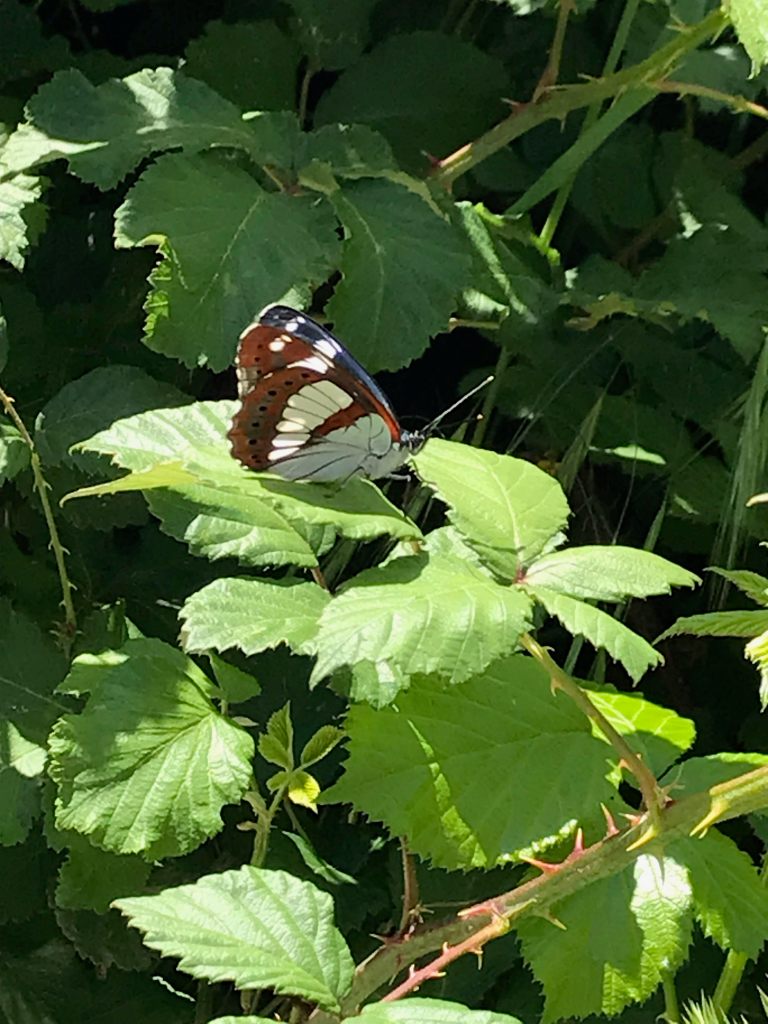
Sylvain Azuré – Southern White Admiral – Limenitis Reducta. Taken with Apple iPhone on 30 April 2023 at the Réserve Ornithologique du Teich.
Foreword on Self-Discipline
Self-discipline is, by definition, the ability to transcend your own wants. It is among the most valuable human characteristics and it defines many people of excellence – good scientists, good walkers, good interlocutors, good soldiers. A great number of us, however, appear to lack self-discipline – we see this in the internet-mediated epidemic of “procrastination” – and it is therefore interesting to examine the question: How can discipline be developed in an adult human being?
When you want to work on yourself – that is, when the task is personal, internal – it is hard to inflame your own natural sympathies: an abstract motivation is needed to act as fulcrum – a lightning rod – for your efforts.
Let us take the following extreme example of a modern white-collar worker: they rent their apartment, they have no long-term partner, their job is boring but intellectually demanding, they may also be living abroad, far from family and friends. They lack many of the things that lend purpose to life and which (through the simple calculus of human psychology) impose discipline, a sense of usefulness and self-worth. A person in this situation must therefore find an external “prompt” – some abstract, ideological motivation – that can act as a surrogate for the loving partner or the fulfilling career. The nature of this prompt is of course entirely arbitrary and can lead to good or bad outcomes. History has already shown us numerous and contradictory interpretations of “The Greater Good”…
Finding an animating principle is difficult in the present social climate, where communities are weak and the Self is sovereign over both God and the Übermensch. Partly this is caused by recent history, which has revealed the horror of what unthinking obedience can achieve in the service of something evil, but it is also driven by technology. An appalling fraction of our lives are now conducted online in virtual environments, either directly via screens or indirectly through algorithmically-curated content – and most of us are concentrated in cities, where technology is more prevalent than in rural areas. So we are living in a world where nature and ideology have become resources, subservient to the individual. Unfortunately, the “Self” is a flimsy foundation of self-discipline. Comfort is no better, and many of us now grow up in situations of material ease. Children who experience a degree of hardship (e.g. physical, financial) naturally and quickly learn that the world does not revolve around their own whims. What follows here is an exploration of self-discipline in adults and, by extension, the education of children.
Where Michaela Meets the Boy Scouts
The modern urban male has a problem: the Übermensch is dead and so is community. Bewildered by world events and buffeted by the merciless strobing of helmet-mounted LEDs, how is he to face the absurd? Without a partner and a satisfying career to absorb him he is at the mercy of reality, untethered from strength-giving abstractions like duty or religion, which means that he needs a source of personal pride and some way to prioritize caring for others1. What he needs, if we dig a little deeper into the marrow, is self-discipline and a ritual system to help embed positive character traits.
Developing rituals is important because habit formation is just a visible artefact of neural change. For better or worse, manners maketh man and we are, in a certain sense, just the aggregation of our internal and external routines. The same idea underpins certain religious customs that are designed to draw your attention to useful thoughts or modes of behaviour. Unfortunately for our hypothetical urban exemplar (and society at large), the closest many of us come to a regular religious experience is taking out the recycling bins.
Bleak as the prospect may appear at the end of a long day at the office, when your self-improvement routine has all the allure of the megot you just trod into the pavement, today we are in the happy position where scientists and psychologists are learning a great deal about habit formation. There is a glut of information online, particularly on YouTube, where millenia-old techniques come in gaudy commercial packaging. We can introduce a morning calisthenics routine for strength, a shower for cleanliness, perhaps a cold shower for bravery or endurance. Before leaving for work we might repeat Niebuhr’s Serenity Prayer, or something from Marcus Aurelius. We can resolve to do at least one selfless deed per day and before going to sleep we can note down five things to be grateful for. The problem is that there is no social reinforcement in this routine and building new habits as an adult is anyway difficult. The most efficient way to acquire good habits is to inculcate them during childhood, as part of one’s education.
Looking at the problems faced by children today, particularly the children of our liberal-seeming middle class, the importance of a decent education is stark. These children have names like “Dash” or “Raven”, they don’t eat carrots or broccoli, have no respect for their parents and little respect for anyone else. Aged five they are taught about the holocaust and transgender rights, but they can eat pasta with their hands if they want to and they can open their Christmas presents on the 23rd if they will “please” stop screaming. When their parents buy a dog, the poor animal is brought up in exactly the same way: adorable to look at, the pitiful creature can’t sit still and will leap in front of cars with little more than an impotent whinge from the owner. What does this picture amount to? If a child is brought up without discipline they risk losing respect for themselves, for other people and the natural world. The difficulty is that nowadays discipline is mistrusted. The 20th Century has shown us what discipline can do in the service of something evil. Now Hegel’s pendulum has swung too far the other way and it is widely considered a fascist aberration.
If discipline is to be developed in a group of young people without tyranny, then some form of holistic doctrine is needed – a principle that can unite them sympathetically and show them that something exists beyond their own childish desires. When thinking about the type of doctrine that is needed to encourage discipline and selflessness it is interesting to examine the writing of Aldous Huxley, since he was deeply interested in education, technology and systems of power – both insofar as they can be used to enslave a population and as a means of individual liberation. In writing Island and Brave New World Revisited, Huxley moved beyond the time-honoured tradition of the author who responds sensitively to the problems around them by simply describing/illuminating them. Drawing together his knowledge of Eastern philosophy and Western scientific techniques, the elder Huxley grappled with the more difficult task of trying to imagine how one could build and maintain a Utopia. Knowing that designing a near-perfect society requires a treatment of humanity at all scales ranging from the individual up to small groups and ultimately mass organization, Huxley was forced to treat topics as diverse as spiritual ideology, agricultural practices, genetics, communal parenting and political organization. On the level of education, he felt the best results could be achieved with a combination of mindfulness and rational-spiritual instruction. He imagines the fictional paradise-island of Pala, where secular rituals are used to bind the community together with shared images, metaphors and values. Violent urges are redirected into physical challenges that are useful either emotionally (for example in athletic achievement/competition) or practically (in chopping wood or hauling heavy loads). The glamorous halo that surrounds physics and engineering in Western societies is shifted towards biology and psychology, which crucially means that humans are not enslaved by their inventions – a lawn mower is not used where a scythe will do and efficiency is not measured in the parochial sense of units of time and units of people. Though Huxley presents his ideas clearly, they are embedded in the context of a fictional tropical island that is (necessarily, as it turns out) isolated from modern society. A more concrete example of what we can do from “within the walls” is provided by Baden-Powell’s boy scouts.
Although many of us associate the scouts with an outmoded institution, primarily useful for teaching small boys how to light fires and tie knots, Baden-Powell developed scouting as a sophisticated system of education that treats all non-academic aspects of a child’s development. There are games to encourage resourcefulness, knowledge of the natural world and physical endurance. Boys are shown how to make money honestly, they are enjoined to help others and to be brave in danger. The neurotic-solipsistic impulse that fuels muscle-building in young men is roundly scorned. Emphasis is placed on duty to others, rather than self-improvement as an end in itself: we are here to serve and we should train ourselves against the day when we are needed. In this way, scouting openly shares many principles with the medieval chivalric code. It instils a sense of duty in each child that hopefully will endure into adulthood.
Prince Philip introduced the Duke of Edinburgh Award to institutionalize some of the most important aspects of scouting, even if it did not necessitate the wearing of a uniform or the joining of an organization. The programme borrowed heavily from Kurt Hahn’s philosophy and pedagogy [1,2]. In his Six Declines of the Modern Youth, Hahn outlined what he saw as the major obstacles faced in the development of children. Here are the Six Declines, as listed by Wikipedia [2]:
Decline of Fitness due to modern methods of locomotion;
Decline of Initiative and Enterprise due to the widespread disease of spectatoritis (i.e. “excessive indulgence in forms of amusement in which one is a passive spectator rather than an active participant”);
Decline of Memory and Imagination due to the confused restlessness of modern life;
Decline of Skill and Care due to the weakened tradition of craftsmanship;
Decline of Self-discipline due to the ever-present availability of stimulants and tranquillisers;
Decline of Compassion due to the unseemly haste with which modern life is conducted or, as William Temple called it, “spiritual death”.
Reading through the list, it is remarkable how few of the points need editing to reflect recent changes in society. Even today, for many children, the Duke of Edinburgh’s Bronze Award remains their first and possibly sole exposure to volunteering or spending time in the countryside. Children are taught how to orient themselves physically in a world that is increasingly virtual [3] and this will only become more important if technology continues to replace human interaction, traditional communities are eroded and animals disappear.
In Landmarks, Robert MacFarlane observes that the Oxford Junior Dictionary is bleeding nature words because they are considered – in many respects rightly – to no longer be relevant to the lives of children. Words as elemental as “acorn”, “ash”, “bluebell” and “buttercup” have been replaced with sterile portmanteaux like “chatroom” and “broadband”. Despite Feynman’s disdain for name-knowing without “classical” understanding2, a name is a hook on which to hang new learning and its loss is greatly damaging. I mention the importance of knowing about and experiencing wilderness in the context of education because discipline can also grow out of confrontation with the unknown, with the chafing of damp boots, as well as through classroom instruction. Shakespeare, as usual, has the measure of it. Here he speaks via the Old Duke in As You Like It, who has been exiled from court and now lives in the forest with those followers still loyal to him:
“Here feel we but the penalty of Adam, The seasons’ difference, as the icy fang And churlish chiding of the winter’s wind, Which when it bites and blows upon my body Even till I shrink with cold, I smile and say ‘This is no flattery: these are counsellors That feelingly persuade me what I am.’ Sweet are the uses of adversity, Which, like the toad, ugly and venomous, Wears yet a precious jewel in his head; And this our life, exempt from public haunt, Finds tongues in trees, books in the running brooks, Sermons in stones, and good in every thing.”
We know it is important to develop discipline when young, so it is natural then to look at how the concept of the “good scout” might be applied to teaching in schools. I thought immediately of a friend who teaches in a London school called Michaela and decided to do a little research on their unusual teaching methods. Reading about the school and its academic ethos, I was struck by how self-consciously the teachers invoked ideas of duty, self-discipline and habit formation when talking about their work.
Michaela achieved notoriety originally for the perceived strictness of the teachers, its traditional (thus atypical) teaching methods and curricula – then later for its exceptional results. The school is located in Brent – a London borough which is ethnically diverse but economically deprived – which means it has to contend with a powerful street culture of gangs and drugs. This only makes the achievements of the school more astonishing, in a period where many schools are losing their bright young teachers due to workload stresses and children’s poor behaviour. Michaela was opened in 2014 and by 2019 its Progress 8 results were among the best in the country [4.1]. The school’s founder and headteacher Katharine Birbalsingh ascribes its success to “small c conservative values” [4.2], which comprise the abstract narrative that all members of the school subscribe to.
In The Power of Culture, Birbalsingh and her colleagues – the other teachers at Michaela – try to explain the principles behind their teaching methods. They describe how the school has rejected the conclusions of the 1967 Plowden Report, which entreated teachers to “allow students to be themselves”, instead trying to give children the essential knowledge and self-control they need to navigate freely in the world. Michaela’s curriculum is therefore centred more on acquiring knowledge than “skills” and teaching is didactic – that is, directed by the teacher rather than the students themselves [4.3]. Following Patrick Deneen [4.4], they believe that the freedom to live well, think for oneself and vote in a truly democratic way is not “a condition into which we are naturally born”, but must be won through a degree of training and “habituation”. Two quotes given in the chapter written by Jonathan Porter are particularly relevant. The first is from Edmund Burke:
“It is written in the eternal constitution of things that men of intemperate natures cannot be free. Their passions forge their fetters.”
And the second from Aristotle’s Nicomachean Ethics:
“Our actions become our habits, our habits become our character, our character is who we are.”
These two quotes are adopted as foundational tenets of Michaela’s approach to education. In their first week of school, pupils are taught about self-control in assemblies and in the classroom. They are encouraged to reflect on so-called “monster moments” – those periods in the day when they may have misbehaved, or lost control of their emotions. Teachers encourage the children by sharing their own monster moments and injecting a little humour. It is a technique that recalls Huxley’s Mynah birds of Pala, which ceaselessly call you to pay “Attention!” to yourself and your surroundings.
To reinforce this doctrine of self-reflection, teachers at Michaela maintain discipline with the lavish and inflexible application of detentions. Though the strictness of teaching at Michaela has proved shocking to many proponents of “child-led” parenting, punishments are designed to promote a culture of excellence over a culture of victimhood and are delivered with great sensitivity. Teacher James Sibley describes how students – even quite seriously troubled individuals – are never given special treatment. Children are taught that they are responsible for their own actions even if, of course, there are aspects of their lives that are difficult and lie beyond their control [4.5]. They must behave for their own good and for the benefit of their peers, who are all “Michaela” – they are exceptional. Sibley observes that this is the model of any “competitive team” [4.6] – they share an aspiration to be the best. To some this may seem a xenophobic and perhaps even psychologically-damaging ethical standard, but at Michaela the importance of building a sense of belonging is considered critical to prevent the children from being seduced by other, easier sources of personal identity, like the very real presence of gangs, or the atavistic values they find online, in music or in films. Pupils are also “taught” gratitude and humility by repeatedly having their attention drawn to moments when others have done something for them [4.7]. It is these values that prevent the “competitive team” mentality from boiling over into an Etonian sense of entitlement.
Whether or not the Michaela approach is correct on all points, Birbalsingh and her colleagues have certainly demonstrated the “power of culture” in education. But what of the unhappy multitude who missed out on Michaela and the boy scouts, who feel rudderless and lack discipline in their adult life? YouTube will suggest the self-help approach mentioned at the beginning, where we drip-feed good activities into our daily routine until a change in personality is produced. An alternative is to embark on a trip that shocks you into a new way of thinking. The Camino de Santiago, or le Chemin de Saint-Jacques, is a good example of this. Walking for weeks and even months with nothing but a bag on your back forces a sort of discipline on you that is profoundly liberating. It also gives you an enormous amount of time for reflection. Scientists are even beginning to study the effects this type of extreme activity has on the human brain [5]. Then there is Alain de Botton’s School of Life, which tries to take self-improvement into adulthood. The company uses books and social media to educate people about a variety of subjects related to love and work and how philosophers can contribute to problems encountered in modern society. They also used to run secular Sunday sermons, which recognized the importance of social reinforcement in building new habits. I remember attending one of their meetings in London when I was at university. There were readings, group songs and a “sermon” from Paul Mason on “Postcapitalism”. While clearly a line-up of fairly limited appeal, the idea of a secular sermon seems to be pushing in the right direction.
Practically the whole history of philosophy is men trying to reason their way out of anxiety. This anxiety can take diverse forms, but it is born out of the conflict between human desire and reality. The rational impulse is to try to attack this emotional problem intellectually, before any action is taken, while the religious response is to draw a line around it and leave the boundary well alone. Neither method is particularly useful. Eventually one needs to stop circling the ineffable and just start doing the things we know to be good. This is, after all, how we teach our children. Eventually these good things become a part of you.
Notes
1This last point about caring for others is no non sequitur: going out of your way to help someone gives you a sense of importance, of purpose, that is fulfilling and helps to transcend the petty wants of the individual.
2Here I am referring to “classical” knowledge as defined by Robert Persig in Zen and the Art of Motorcycle Maintenance.
Clumsy photo of a Black-winged stilt (Himantopus himantopus). Taken with Apple iPhone on 30 April 2023 at the Réserve Ornithologique du Teich.




 Philip Bradford